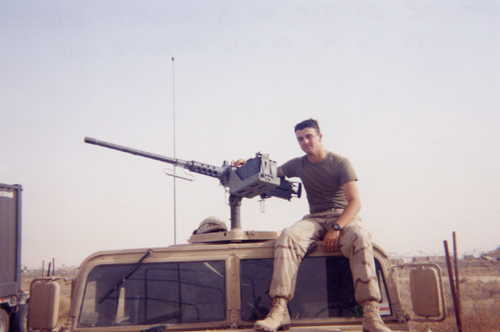
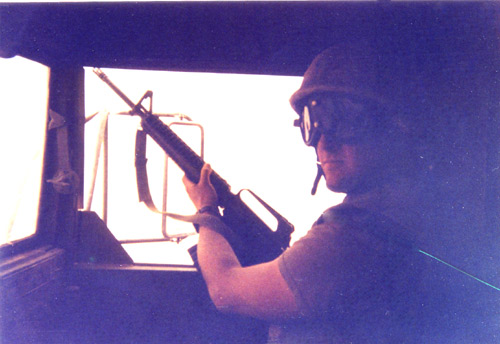
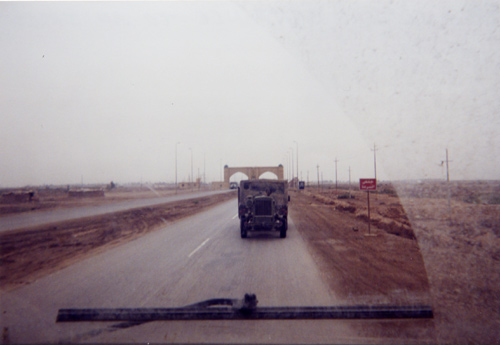
Along the route north, my convoy consisted of fuel tanker trucks, flat-bed semi’s carrying ammo, food, water, etc. and low boy trailers hauling our heavy equipment. We were in support of keeping all entities able and moving forward. Guarded by a handful of humvees, armed to the teeth yet un-armored in build. Placed at intervals throughout the precession, they were our first line of defense in an attack. My driver and I, using materials readily available, sandbagged the floor and dash of our cab as to thwart any frag from underneath in the event of an explosion, or rounds coming in at chest level.
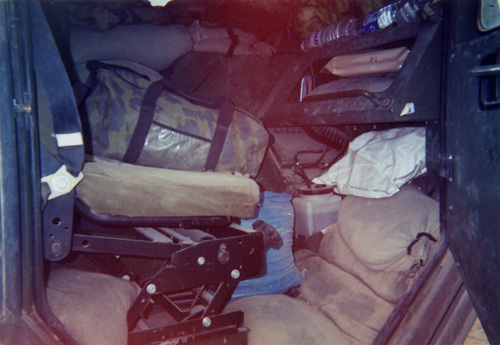
Up ahead, a few trucks of ours pulled aside to assist two of our own. One disabled humvee with a blown tire on its trailer in tow. The other a flat-bed truck hauling ordnance that had shifted dangerously off to the side while en route. I was told to get the front end loader tractor with fork attachment down off a trailer and bring it around.
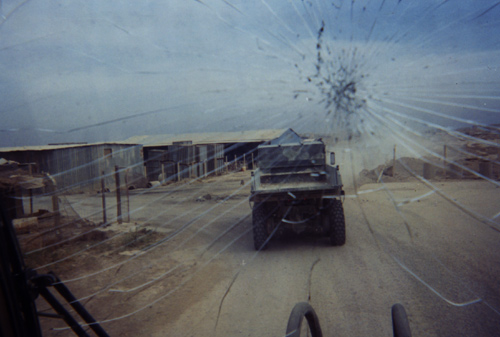
First off, there wasn’t a replacement for the tire that had blown, nor the time to fix it if we had one. Orders came to lift the entire trailer up, carry it, and place it onto the back of another larger trailer about a hundred yards away….carefully. Carefully, is what I was “repeatedly” told by the driver who was pulling it when the tire blew out. As run of the mill as a task like this was to me, I gave him a head nod concurring with what he was stressing to me, just as I did everyone, not even taking the time to make eye contact. Nothing to it…pick it up…move it over there…set it down…nuff said. Mission accomplished. Upon seeing this task complete, my overly cautious friend climbed up to help tie the trailer down and started to wave at me as I pulled away. At second glance, upon noticing he finally had my attention, he pulled back the canvas cover to the trailer I had haphazardly carried nearly a football field. I literally stopped in my tracks as I read the labels on the wooden crates housed inside the trailer. Caution…High Explosive…No Smoking…etc. The “I told you so” look on his face was all that need to be said. Needless to say, my overconfident attitude was non-existent regarding the next task I faced, “repositioning” a crate of missiles back onto a trailer that had shifted and were left hanging off the passenger side. With much attention to detail and moving at a snail’s pace, I secured the cargo and we were off again.
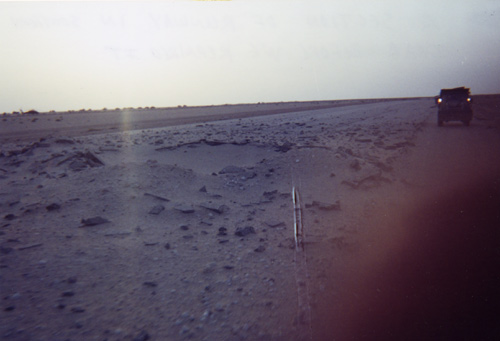
Many days later we had finally arrived at our objective. An Iraqi airfield south of Baghdad that was in dire need of repair (due to the U.S. blowing it up back in the first desert storm) that would serve as a re-supply point and medical treatment facility for those injured in the offensive to take the capital city. Pictured below is a portion of the runway before it was repaired.
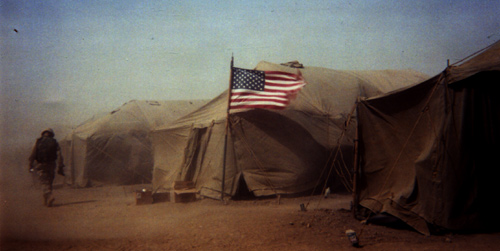
We set up camp and dug in.
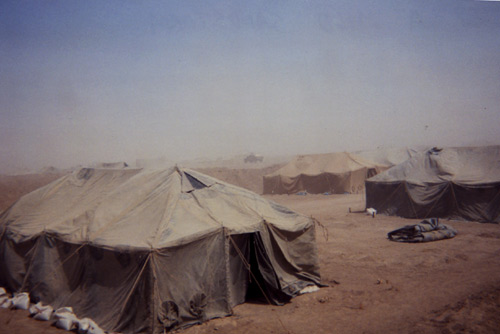
One morning I woke up to a sight I hadn’t expected. Apparently, a lone U.S. Army tank had become separated from its battalion and had been wandering the desert for days on end, coasting into our camp on fumes with little to no supplies left. I later learned that they were nearly fired upon by our own base defenses after failing to identify themselves on approach in the dark.
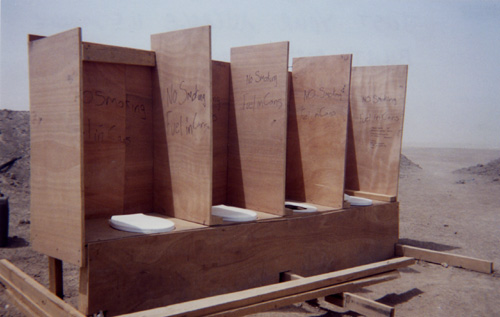
“Bathroom Facilities” constructed only of the highest caliber and always with privacy in mind, by US Marines.
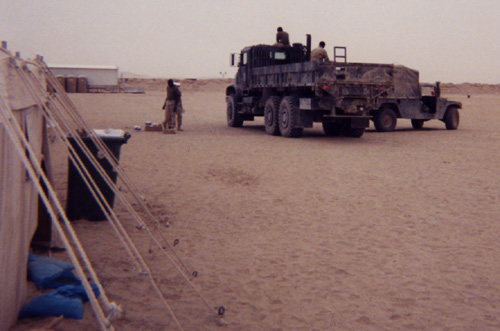
Mail Truck!
Interacting with the majority of locals was a friendly event in most cases around our camp. One day, I was working on the grounds of a nearby abandon cement factory and had a chance to meet and interact with a family who lived closely to it. I exchanged waves and smiles with the children many times, but this was the first occasion I had spoken to the adults face to face. After an initial handshake and momentary awkward silence, we were able to communicate through one of his sons, “Hydar” who spoke surprisingly fluent english for an Iraqi ten-year old boy! The conversation that developed between us, would forever change and fortify my personal opinion of the war in Iraq. Toward the end of our conversation, the boy’s father began to tear up slightly… I became confused and didn’t know how to react by his sudden silence. Shortly after, he began to speak, and his sons translation is as follows: “We are so glad that you are here to free us from the rule of Saddam. (tears of joy). My family has lived in fear for so long, I do not wish my family to live under the rule of Saddam any longer…Please do not leave us and let him come back (tears of sadness).” I had no words to say to him at this point, having caught me a bit off guard. I guess I wasn’t expecting him to speak so transparent from his heart. Even to this day, I still recall the hopes and fears he shared with me that afternoon.
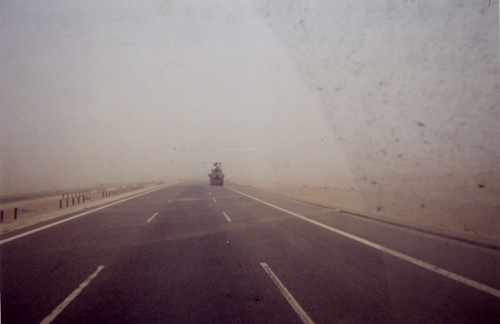
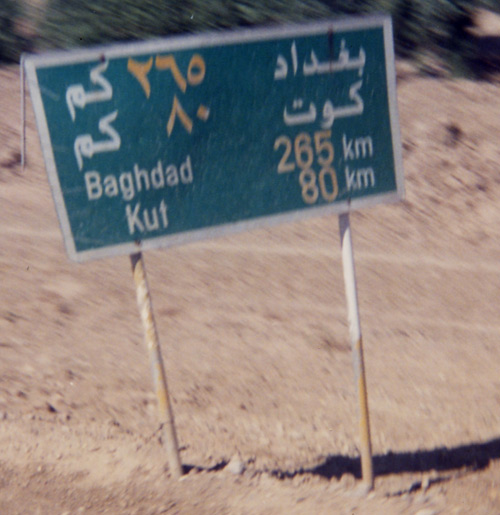
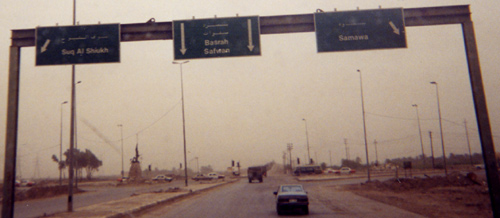
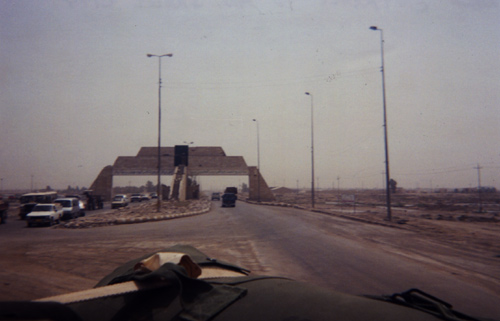
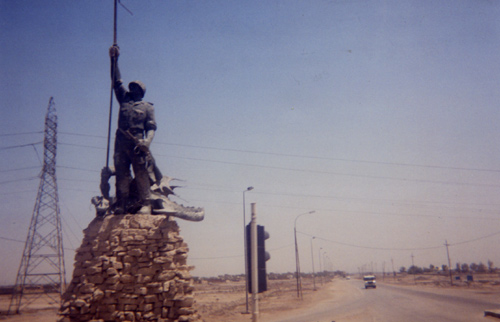
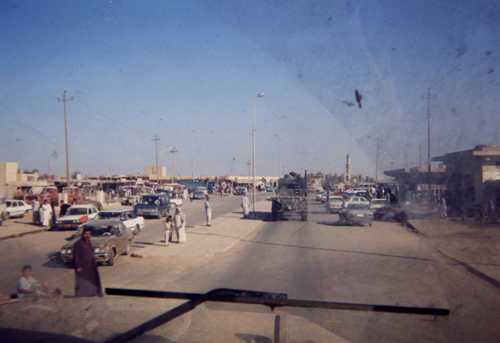
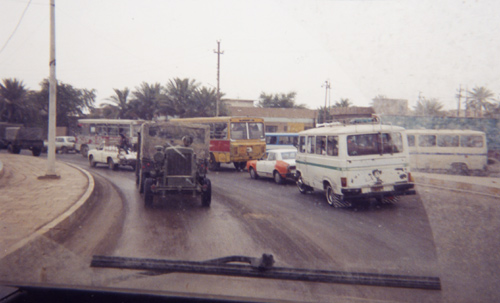
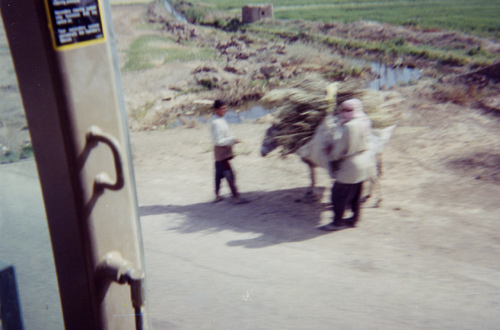
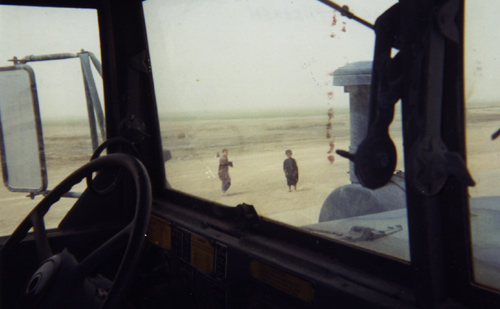
In the weeks and months that followed, I witnessed many sights while en route back and forth to Kuwait City assisting convoys of more supplies coming north.
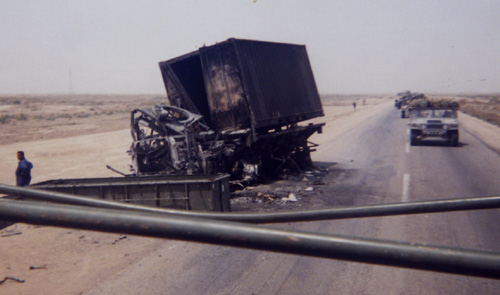
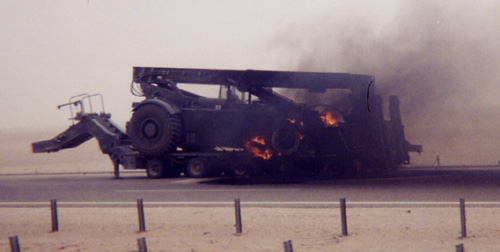
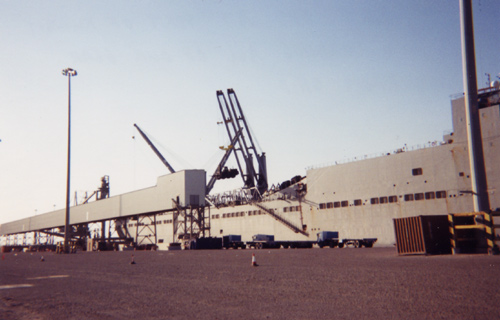
After a few months, my unit was ordered to pack up and head back to the port of Kuwait. More troops were arriving to replace us. This shot was taken at the end of the last convoy I had to make coming out of Iraq. Finally, the vest and helmet were off for good!
All that was left was to load some of our trucks onto the ship before heading home.
It honestly wasn’t until I had returned home for a few months, that I took grasp at what just happened. All the tragedies, close calls, near misses, and so forth. I thank God every day for protecting me while I was there and comforting me when I needed it most. You can say the war was a glorious success or a place we had no business sticking our nose. But I can rest my head at night knowing I helped give that father a better place to raise his son.
At least…thats how I saw it.
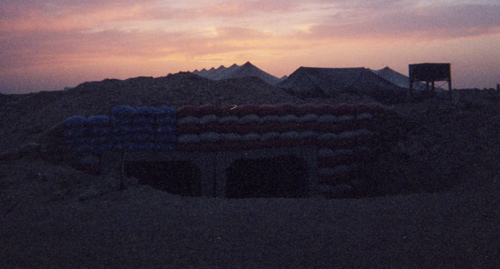
(Below is the official statement from a government website regarding my unit’s actions)
February of 2003 found elements of MWSS-271 returning to SWA in support of Operation Enduring Freedom. As war with Iraq appeared imminent, the Squadron began the year deeply involved in contingency planning and embarkation preparation. The Commanding Officer and other key planners deployed to Al Jaber Air Base, Kuwait, in early February to conduct more detailed operational planning. The Squadron’s advanced party arrived one week later and received the mission to establish an expeditionary camp in the northern Kuwaiti desert. With a few Marines and a host of borrowed equipment, the Squadron created a 31 acre fortified camp, dubbed Camp Workhorse, that would support as many as 3200 Marines and Sailors and become the pre-war staging area for all 3d MAW ground units. Upon commencement of Operation Iraqi Freedom, MWSS-271 crossed into Iraq and established three FARPs and one Tactical Landing Zone (TLZ) enroute to its objective, An Numaniyah. Five kilometers west on An Numaniyah, MWSS-271 established FOB Three Rivers, installing a 440,000 gallon fuel system; airfield lighting for a 9600-foot runway with taxiways; M-21 arresting gear for recovering tail hook aircraft; a mobi-mat MEDEVAC HLZ; and a water production point with over 50,000 gallons of storage capacity. Additionally the squadron coordinated security for the FOB inclusive of an adjoining LSA operated by the 1st FSSG. The Squadron conducted 10 tactical recoveries of downed aircraft, line hauled fuel for 1st FSSG, and conducted resupply convoys to Division and other Wing elements. While continuing to operate Three Rivers, the Squadron established two FARPs IVO Tikrit. On 28 April, the Squadron began retrograding with the final complement of the Squadron arriving home on 17 June 2003.
 Educated Rambling